.png)
Last reviewed: July 2026
A pet deposit is refundable money held against pet damage. A pet fee is a one-time, non-refundable charge with no recovery at move-out. If you are reviewing a lease as a renter with pets, here is what each charge means and which one you can get back. Typical pet deposits run $200-$500 and pet fees run $100-$400 (as of Q2 2026). A third charge, pet rent, adds $25-$75/month on top of both.
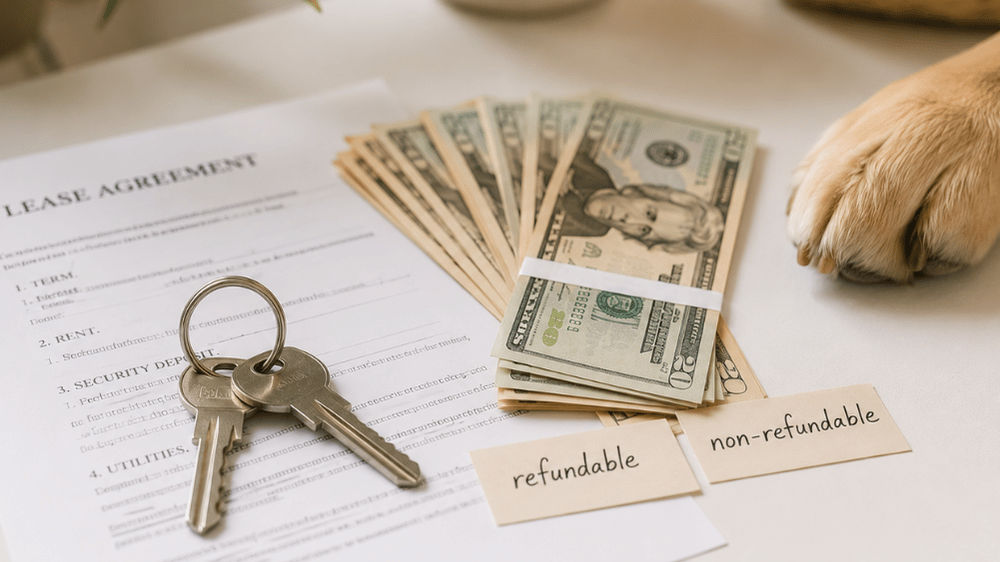
A pet deposit is money you can get back. A pet fee is money you cannot. Everything else is detail.
Pet deposit: A pet deposit is a refundable amount held by the landlord and returned at move-out, minus the cost of any documented damage caused by the pet.
Pet fee: A pet fee is a one-time, non-refundable charge paid at move-in that the landlord keeps regardless of whether the pet causes any damage.
Pet rent: Pet rent is a recurring monthly charge added to the base rent for the duration of the tenancy, with no refund at any point.
Many leases include two or all three of these charges simultaneously. Check your lease for each one individually before signing.
Pet Deposit: Refundable (if no damage). Paid at move-in. $200-$500 typical (as of Q2 2026). Covers actual pet damage at move-out.
Pet Fee: Not refundable. Paid at move-in. $100-$400 typical (as of Q2 2026). Covers general wear, upfront risk.
Pet Rent: Not refundable. Paid monthly. $25-$75/mo typical (as of Q2 2026). Covers ongoing wear and tear.
In most states, landlords can charge all three at the same time. The refundability of the deposit is the single most important distinction for your wallet. If your pet causes no damage and you documented the unit's condition at move-in, the deposit comes back. The fee and the rent do not, under any circumstances.
Searching for a pet-friendly apartment? brightplace shows which buildings in your city charge pet fees, pet rent, or both, so you can compare costs before you apply. Search at app.brightplace.ai.
A pet deposit is paid at move-in and held by the landlord for the duration of the lease. At move-out, the landlord inspects the unit for pet-specific damage (scratched floors, stained carpet, chewed trim). If no pet damage is found, the full deposit is returned. If damage exists, the landlord deducts repair costs and returns the remainder. Normal wear and tear describes the gradual deterioration expected from everyday use, which landlords cannot deduct from any deposit.
In most states, pet deposits are governed by the same laws as security deposits, including return deadlines (typically 14-30 days after move-out). Three states with specific pet deposit rules worth knowing:
California: Total security deposit (including pet deposit) is capped at one month's rent under AB 12, effective July 2024 (California Civil Code Section 1950.5).
Colorado: Pet deposits capped at $300 under HB23-1068 (Colorado Revised Statutes § 38-12-106).
Seattle, WA: Pet deposits capped at 25% of one month's rent (as of Q2 2026).
Document the unit with photos before move-in to protect your deposit at move-out. For more on this process, see brightplace's guide to renting an apartment.
A pet fee is paid at move-in and gone. The landlord keeps it regardless of how the pet behaves or what condition the unit is in at move-out. No documentation is required from the landlord, and no itemization obligation exists.
State rules vary. California prohibits non-refundable pet fees entirely. Any upfront payment related to a pet is treated as a security deposit under Civil Code 1950.5 and must be refundable. New York limits total deposits, which effectively restricts large upfront pet fees. Texas and Florida permit non-refundable pet fees with proper lease disclosure.
If your lease includes a non-refundable pet fee, confirm it is labeled correctly and that your state allows it. A pet addendum is a separate document attached to the lease that specifies all pet-related charges, rules, and the renter's liability for damage. Request a copy before signing.
Pet rent is the most expensive structure for renters over time, and the one most renters underestimate.
$50/month in pet rent over a 12-month lease equals $600 with zero chance of recovery. Over 24 months, that is $1,200. A $300 non-refundable pet fee costs half as much and ends after one payment. A $400 refundable deposit costs the same upfront but comes back if the pet causes no damage.
Here is the full picture for a building that charges all three: a $300 non-refundable pet fee, a $400 refundable deposit, and $50/month pet rent. Your Year 1 total non-recoverable cost is $900 ($300 fee + $600 pet rent). Your recoverable amount is $400 (the deposit, if no damage). Over two years, the non-recoverable total rises to $1,500. For a complete breakdown of what renters pay beyond base rent, see brightplace's guide to your true monthly cost.
A refundable pet deposit is the most favorable structure for renters with well-behaved pets on leases of 12 months or longer. If your pet has never scratched a floor in its life, a refundable deposit is almost always the better deal because you get the money back.
A non-refundable pet fee is more predictable for short leases or renters whose pets have a history of accidents. You pay once, owe nothing further, and do not risk a disputed deduction at move-out.
Pet rent is the least favorable structure for any renter staying longer than six months. The cumulative cost exceeds both a deposit and a fee within the first year, and none of it is recoverable. If you have the option to negotiate, push for a higher refundable deposit instead of monthly pet rent.
Under the Fair Housing Act, landlords cannot charge a pet deposit, pet fee, or pet rent for a verified service animal or emotional support animal (ESA). Renters with a valid ESA letter from a licensed healthcare provider should not be charged any pet-related fees. They can still be held responsible for actual damage through the standard security deposit. For more on how this works, see brightplace's guide to pet-friendly apartments.
Five items to verify in the lease before you sign:
No. A pet deposit is refundable. It is held by the landlord and returned at move-out if the pet causes no damage. A pet fee is non-refundable. The landlord keeps it regardless of the unit's condition at move-out. Both may be charged on the same lease, and the distinction directly affects how much money you recover.
Most landlords charge per pet. If you have two cats, expect two deposits and two monthly pet rent charges. Some buildings charge a single flat deposit regardless of pet count, but this is less common. Confirm the per-pet policy before applying, especially if you have more than one animal.
Yes, in most states. Landlords can charge a pet deposit, a pet fee, and monthly pet rent simultaneously. The combined total must still comply with state deposit caps where applicable (California, Colorado, Seattle). Check your state's landlord-tenant statute if the total charges seem excessive.
Pet deposits for dogs typically run $250-$500, while cat deposits run $200-$400 (as of Q2 2026). Dogs generally carry higher deposits because they pose more risk of damage to floors, doors, and yard areas. Some landlords charge the same amount regardless of pet type. Always confirm the specific figure in the lease.
The landlord must return the full pet deposit within the state-required timeframe, typically 14-30 days after move-out. Document the unit's condition with dated photos at both move-in and move-out. If the landlord deducts for pre-existing damage, your move-in photos are your evidence for disputing the deduction.
No. California prohibits non-refundable pet fees. Under Civil Code Section 1950.5, any upfront payment related to a pet is treated as a security deposit and must be refundable. The total deposit (security + pet) is capped at one month's rent for most landlords as of July 2024 under AB 12.
See pet-friendly apartments across your city on brightplace.
We'll find a place that you'll actually love