
How Much Rent You Can Afford on $18 an Hour
$18 an hour at 40 hours/week produces $3,120/month gross income. The 30% rule puts your rent ceiling at $936/month. Here is how debt, location, and part-time hours change that number.
Your Rent Target at $18 an Hour
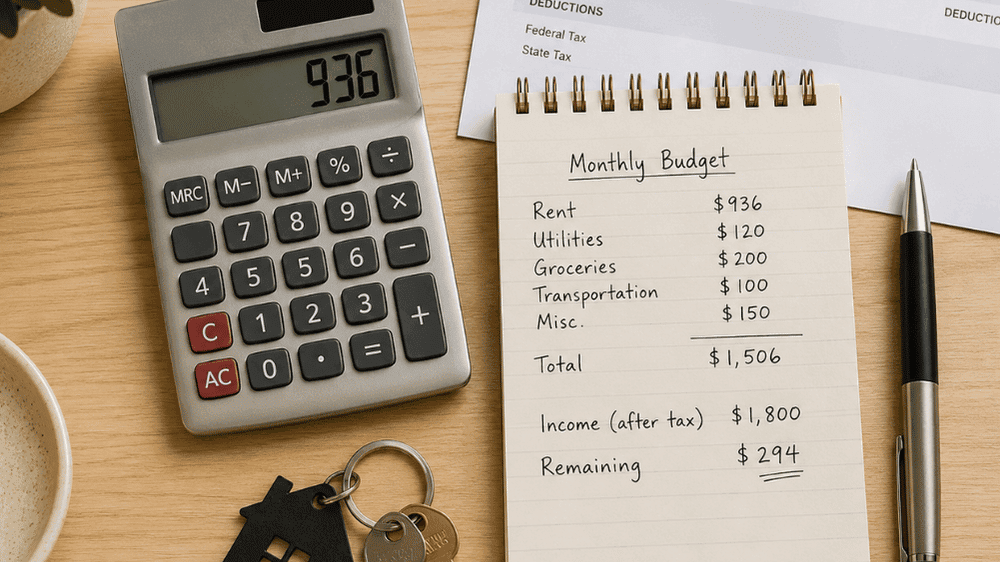
$18 an hour, working a standard 40-hour week, produces a gross monthly income of $3,120. At the standard 30% rule, your rent target is $936/month. The 30% rule is a budgeting guideline that recommends spending no more than 30% of your gross monthly income on rent. That is the number most financial planners and landlords use as a starting point when you earn this wage. If you earn $18/hour at full-time hours and want a specific rent budget before you start searching, $936/month is the baseline.
Some sources calculate affordability using 48 paid weeks instead of 52 (accounting for workers without paid time off), which produces a gross monthly income of $2,880 and a 30% ceiling of $864/month. If you do not receive paid vacation, the $864 figure may be a more realistic target.
For context, the National Low Income Housing Coalition's 2026 Out of Reach Report found that a full-time worker needs $29.19/hour to afford a modest one-bedroom apartment nationally and $34.73/hour for a two-bedroom. At $18/hour, you earn $11.19 less than the national one-bedroom housing wage, which is why location matters so much at this income level.
brightplace lets you search by rent range across your city. See what is available within your budget at app.brightplace.ai.
How $18 an Hour Translates to Monthly Income
Understanding the difference between gross and net income is critical before setting a rent budget. Gross monthly income is the total amount you earn before taxes and deductions are taken out. Take-home pay (also called net income) is what lands in your bank account after federal income tax, Social Security, and Medicare are deducted.
Per hour: $18.00
Per week (40 hrs): $720
Per month (approx.): $3,120
Per year: $37,440
Est. monthly take-home: ~$2,450-$2,600 (as of Q3 2026)
Take-home varies by state. States with no income tax (Texas, Florida, Nevada, Tennessee, among others) put more in your pocket. The take-home estimate above reflects federal taxes, Social Security, and Medicare only. Note that 22 states raised their minimum wages in 2026, and in some jurisdictions $18/hour is now close to the legal minimum. Washington state's minimum wage is $17.13/hour, and New York City's is $17.00/hour (as of Q3 2026).
The Rules Landlords and Planners Use
Three rules produce different rent ceilings at this income level. The gap between them matters.
The 3x rent rule is the most common landlord qualification standard: your gross monthly income must be at least three times the monthly rent. At $3,120 gross, you qualify for up to $1,040/month under this test. That is higher than the 30% rule ceiling because landlords use a looser threshold than financial planners recommend.
The 50/30/20 rule allocates 50% of take-home pay to needs (including rent), 30% to wants, and 20% to savings or debt paydown. Under this rule, all essential needs combined should stay under $1,250-$1,300/month, leaving rent at $700-$900/month after other essentials.
30% of gross income: Max rent = 30% of $3,120 = $936/month.
3x rent (landlord test): Gross income must be 3x rent. Qualifies up to ~$1,040/month.
50/30/20 rule (needs bucket): All needs within 50% of take-home = $700-$900/month for rent after other essentials.
Conservative (25% of gross): Lower ceiling for financial cushion = $780/month.
What $936 in Rent Actually Buys You, by City
The $936 number means nothing without context. Here is where that budget is realistic for a solo 1-bedroom apartment (as of Q3 2026).
Cities where $936/month covers a 1BR: Memphis, TN. Wichita, KS. Oklahoma City, OK. El Paso, TX. Cleveland, OH. Birmingham, AL. Louisville, KY. These markets have 1BR inventory at or below this price point with access to grocery, transit, and employment corridors. For other affordable places to live, see brightplace's Florida guide.
Cities where $936 requires a studio or roommate: Phoenix, AZ (1BR averages $1,077-$1,348, as of Q3 2026). San Antonio, TX (1BR averages $955-$1,177, as of Q3 2026). In these mid-tier markets, solo 1BR rents put them above the 30% threshold without a roommate or a studio unit.
Cities where $18/hour is not viable for solo renting: Dallas, TX (1BR averages $1,415-$1,475, as of Q3 2026). Despite no state income tax, Dallas rents have risen well beyond what $18/hour supports for solo renting. A roommate or shared housing is the primary path. The same applies to all large coastal metros.
In large coastal metros, $936/month is not realistic for solo renting. A roommate is the primary path to affordability in those markets. brightplace tracks rental supply across these markets. As of Q3 2026, 1BR apartments at or below $950/month remain findable in the lower-cost cities listed above. Renters exploring apartments with no credit check may find additional flexibility. Search by rent ceiling at app.brightplace.ai.
How Debt and Other Bills Change Your Real Ceiling
The 30% rule assumes zero existing debt. Most renters carry some. When you factor in typical debt loads, the practical rent ceiling drops noticeably below the headline $936 figure.
$0 monthly debt: Recommended rent ceiling $780-$936. Remaining for food, transport, savings: $1,500-$1,700.
$200-$350 (one loan/payment): Recommended rent ceiling $650-$800. Remaining: $1,300-$1,500.
$400-$600 (car + student loan): Recommended rent ceiling $550-$700. Remaining: $1,100-$1,300.
$600+ (multiple debts): Recommended rent ceiling $500-$600. Remaining: below comfortable threshold.
Based on estimated $2,500/month take-home. Adjust for actual pay stubs. A $300/month car payment and $150/month student loan minimum ($450 total) effectively lowers the practical rent ceiling by approximately $200-$300/month on this income. For a complete cost breakdown beyond base rent, see brightplace's guide to your true monthly cost. Renters considering prorated rent for mid-month move-ins should factor that into first-month budgeting.
The Roommate Math at $18 an Hour
A roommate is the most effective affordability tool at this income level. Splitting a 2BR apartment priced at $1,600/month means each person pays $800, well inside the 30% threshold. It also opens access to cities and neighborhoods where solo 1BR rents exceed $936/month.
In Phoenix, Dallas, or San Antonio, a shared 2BR puts individual rent at $700-$900/month, making mid-tier metros accessible on $18/hour. If you are sharing with a roommate, brightplace's guide to renters insurance with roommates covers whether to share a policy or carry separate ones. For renters new to the process, brightplace's guide to renting an apartment covers the full application process.
What to Know About $18 an Hour Part-Time
Part-time hours change every figure in this article.
At 30 hours/week: Gross monthly income drops to approximately $2,340. The 30% rent ceiling falls to $702/month (as of Q3 2026).
At 25 hours/week: Gross monthly income is approximately $1,950. The 30% rent ceiling is $585/month.
Use your guaranteed regular hours when calculating a rent budget, not your best-week hours. Landlords verify income with pay stubs or tax returns, and inconsistent hours can disqualify you from the 3x rent test. Renters who qualify may benefit from income-restricted housing, which sets rent based on a percentage of area median income.
Can I Live Off $18 an Hour?
It depends on location, household size, and debt load. In lower-cost markets with rent at or below $936/month, $18/hour is livable for a single adult without significant debt. $18/hour in Memphis with $900 rent and no car payment leaves approximately $800-$1,000 after rent and basic utilities for food, transportation, and savings. That is workable, not comfortable. In major coastal metros, it is not sufficient for solo renting without a roommate. Wage growth has not kept pace with rental cost increases in most major metros, which is a real constraint this income level faces. According to the 2026 Out of Reach Report, 17 of the 25 most common U.S. occupations pay below the one-bedroom housing wage. For renters on a tight budget, exploring cheap one-bedroom apartments on brightplace can surface options within reach.
Frequently Asked Questions
What is the 30% rent rule?
The 30% rule states that your monthly rent should not exceed 30% of your gross monthly income. At $18/hour with $3,120 in monthly gross income, that puts your ceiling at $936/month. It is a starting point, not a guarantee: debt, utilities, and savings goals can all lower your practical ceiling below this number.
How much is $18 an hour per month?
$18/hour at a standard 40-hour workweek produces a gross monthly income of approximately $3,120, or $37,440 per year. After federal income tax, Social Security, and Medicare, estimated take-home pay is $2,450-$2,600/month (as of Q3 2026), depending on your state. States with no income tax increase take-home slightly.
What apartments can I afford on $18 an hour?
At $18/hour, a realistic rent budget of $780-$936/month opens solo 1BR options in lower-cost markets like Memphis, Wichita, Oklahoma City, and El Paso. In mid-tier cities like Phoenix or San Antonio, you are looking at studios or shared 2BR apartments. Dallas and high-cost coastal metros require a roommate at this income level (as of Q3 2026).
How much rent can I afford making $18 an hour part time?
Part-time hours change the math significantly. At 30 hours/week, your gross monthly income drops to approximately $2,340, putting your 30% rent ceiling at $702/month. At 25 hours/week, it falls to roughly $585/month. Always calculate your budget from your actual regular hours, not from a full-time assumption.
What salary do I need to afford $1,200 rent?
To keep $1,200/month rent at 30% of gross income, you need $4,000/month gross, or about $24/hour at full-time hours. At $18/hour ($3,120 gross), $1,200 in rent represents nearly 38.5% of your income. That can work if you carry no other monthly debt and your other housing costs (utilities, parking) are low.
How does having a roommate change my rent budget at $18 an hour?
A roommate is the most effective affordability tool at this income level. Splitting a 2BR apartment priced at $1,600/month means each person pays $800, well inside the 30% threshold. It also opens access to cities and neighborhoods where solo 1BR rents exceed $936/month.
How much of my income should go to rent versus other bills?
Under the 50/30/20 rule, all essential needs (rent, utilities, groceries, transportation, minimum debt payments) should stay within 50% of take-home pay. At roughly $2,500/month take-home, that is a $1,250 ceiling for all essentials combined. Rent should typically be the largest single item but should leave room for utilities ($100-$180), food, and transport.
Can I afford $2,000/month in rent on $18 an hour?
No. $2,000/month in rent on $3,120 gross monthly income represents 64% of your gross income, more than twice the recommended 30% threshold. To afford $2,000/month comfortably under the 30% rule, you would need a gross income of approximately $6,667/month, or roughly $40/hour at full-time hours.
Is $18 an hour a living wage in 2026?
It depends entirely on where you live. According to the 2026 Out of Reach Report, the national housing wage for a modest one-bedroom is $29.19/hour. At $18/hour, you fall $11.19 short of that benchmark. In lower-cost cities like Memphis, Wichita, and El Paso, $18/hour covers basic living expenses for a single adult. In mid-tier and coastal metros, it does not without a roommate or supplemental income.
What is the housing wage for a one-bedroom apartment in 2026?
The National Low Income Housing Coalition's 2026 Out of Reach Report calculates the national housing wage at $29.19/hour for a modest one-bedroom and $34.73/hour for a two-bedroom. The average renter wage is $24.84/hour. Nearly 48% of the U.S. workforce works in occupations paying below the two-bedroom housing wage.
Can I afford rent in Dallas on $18 an hour?
Solo renting a one-bedroom in Dallas is very difficult on $18/hour. As of Q3 2026, 1BR apartments in Dallas average $1,415-$1,475/month, which represents over 45% of gross income at this wage. A shared two-bedroom or studio is the realistic path. Dallas has no state income tax, which helps take-home pay, but not enough to close the gap for a solo one-bedroom.
What cities can you afford on $18 an hour in 2026?
Cities where $936/month covers a solo 1BR include Memphis, TN, Wichita, KS, Oklahoma City, OK, El Paso, TX, Cleveland, OH, Birmingham, AL, and Louisville, KY (as of Q3 2026). These markets offer 1BR inventory at or below the 30% threshold with access to employment, transit, and services.
brightplace lets you search by rent range across your city. See what is available within your budget at app.brightplace.ai.