.png)
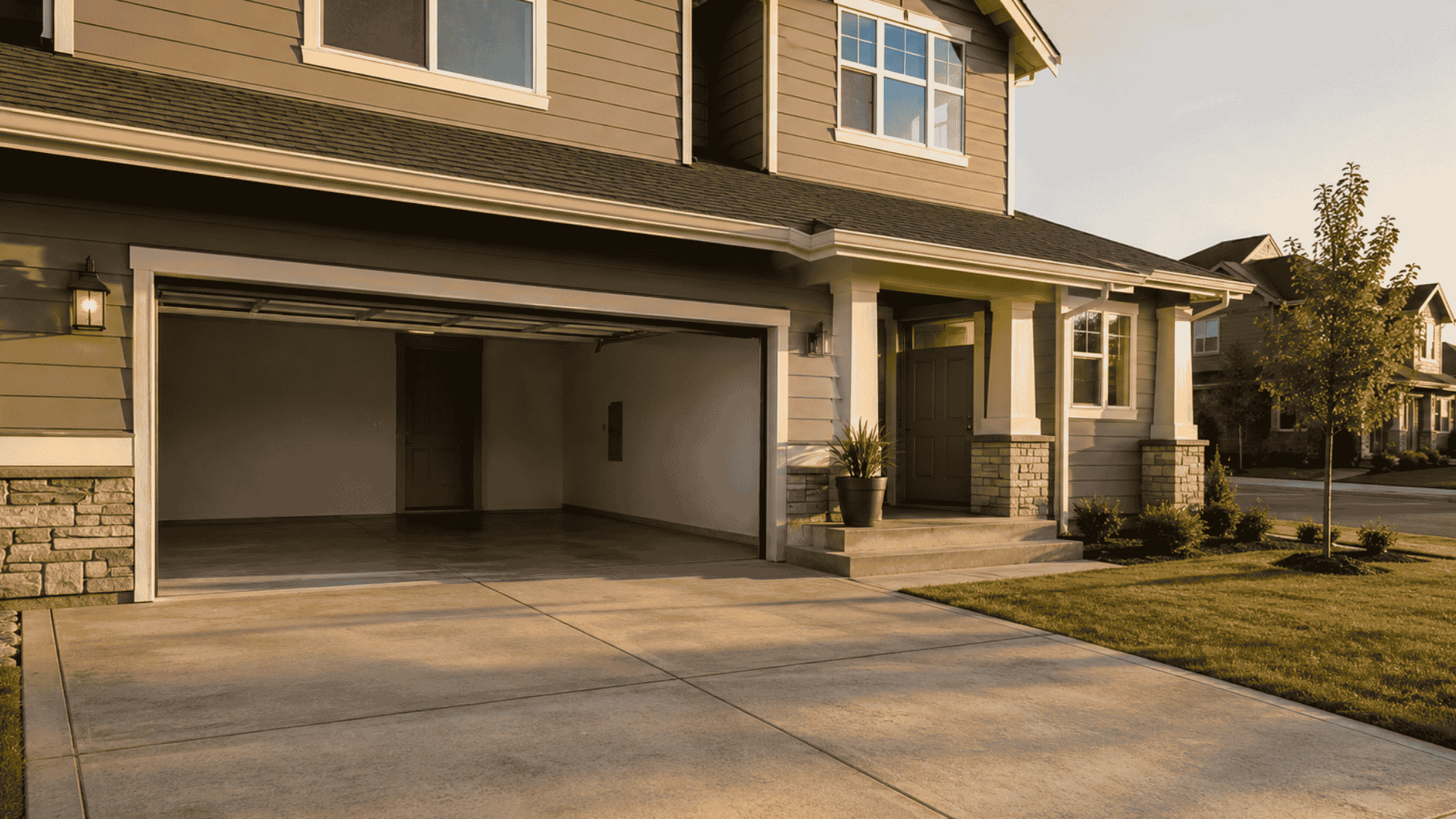
An attached garage is a private, enclosed garage that connects directly to the interior of the unit, allowing entry from inside the home without going outside. Apartments with attached garages make up a small fraction of total rental inventory in most markets, concentrated in suburban townhouse communities and single-family rental homes (as of Q2 2026). Renters searching for this amenity need to know the difference between four parking types before they start filtering listings.
Attached garage: A private garage that shares a wall with your unit and connects to the interior. You walk from your car into your home without stepping outside.
Detached garage: An enclosed parking structure assigned to your unit but located in a separate building. You walk outside to reach it.
Covered parking / carport: A sheltered space with a roof but no enclosed walls or lockable door. No security, no climate control.
Reserved parking: An assigned surface or deck space, typically open-air. No enclosure at all.
Before scheduling a tour, ask the leasing office one question: "Does the garage share a wall with my unit and connect to the interior?" If they cannot confirm, it is not an attached garage. The U.S. Department of Housing and Urban Development's rental checklist recommends verifying all amenities in writing before signing any lease.
brightplace searches across apartment types and surfaces attached garage availability where listed. See what is currently available in your area at app.brightplace.ai.
Attached garages require a specific structural configuration. The garage must sit at ground level and share a wall with the living space. That rules out most traditional apartment buildings. Here is where this amenity actually exists (as of Q2 2026):
Townhouse / rowhouse: High availability. $1,400-$2,500/mo. Ground-floor garage with living space above. Most common format for attached garages in the rental market.
Single-family rental home: High availability. $1,800-$3,500/mo. Usually one or two car garage. Higher price point but the most space.
Condo rental: Moderate availability. $1,500-$2,800/mo. May share a building garage structure. Verify whether the garage connects to the unit or to a common hallway.
Garden-style apartment: Low availability. $1,100-$2,000/mo. Parking is usually detached or covered. Attached garages are structurally rare in this format.
Mid-rise / high-rise apartment: Very low availability. $1,600-$4,000+/mo. Parking is almost always structured deck or underground. Attached garages are structurally impossible in most high-rise designs.
Townhouses are the most reliable building type for this amenity. If you want an attached garage, start your search by filtering for townhouse-style units rather than traditional apartments. For a broader look at what monthly costs include beyond base rent, see your true monthly cost as a renter.
Start by filtering for townhouse or single-family rental formats. A generic "parking" amenity filter aggregates multiple parking types (attached, detached, covered, reserved) into a single category. Filtering by "parking available" and assuming that includes an attached garage is the most common search mistake brightplace sees for this amenity.
Narrow your search to suburban zones. Attached garage inventory is concentrated in suburban rings, not urban cores. Expanding your search radius by 10-15 miles from a city center can triple your available options in most metros.
Check private landlord listings. Individual homeowners who rent one or two properties are more likely to offer homes with attached garages than large institutional operators. Local real estate agents who handle rental placements can connect you with this inventory.
Verify before applying. Contact the leasing office or landlord directly and confirm three things: (1) the garage connects to the unit interior, (2) the garage is included in the listed rent or billed separately, and (3) there are no HOA restrictions on what you can store in the garage. Application fees run $50-$85 per adult (as of Q2 2026), so verification before applying saves real money. brightplace's guide on how to rent an apartment walks through what to prepare before you start touring.
Use brightplace to search for townhouses and rental homes in your target area at app.brightplace.ai.
Apartments with attached garages typically rent at a 10-20% premium over comparable units without dedicated parking (as of Q2 2026). A two-bedroom townhouse that would rent for $1,600 without a garage might list at $1,760-$1,920 with one.
In some markets, the garage is not included in the listed rent. It is billed as a separate monthly add-on, typically $75 to $200 per month (as of Q2 2026). This is a cost that most renters do not discover until they contact the property.
Here is a worked example of how garage costs affect your annual budget. A unit listed at $1,500/mo with a $150 garage add-on costs $1,650/mo. Over a 12-month lease, that is $19,800 instead of $18,000, a difference of $1,800 per year. If you also factor in renter's insurance (which may adjust for garage storage) and the savings from avoiding a separate parking garage fee ($100-$250/mo in urban areas), an attached garage can break even or save money depending on your metro. For a full breakdown of costs beyond base rent, see brightplace's guide to your true monthly cost.
The question to always ask: "Is the garage included in the listed rent, or is it an additional monthly fee?"
Attached garage rental inventory clusters in suburban rings of mid-size and major metros (as of Q2 2026). Two geographic patterns dominate.
Dallas-Fort Worth suburbs have the highest concentration nationally. Plano, Allen, McKinney, and Frisco all have significant townhouse and build-to-rent communities with attached garages. Rents for a two-bedroom townhouse with an attached garage in these suburbs range from $1,600 to $2,400/mo (as of Q2 2026). The Texas Department of Housing and Community Affairs tracks affordable rental inventory across the state for renters comparing options. brightplace's Dallas families guide covers the broader rental picture in these suburbs.
Houston suburbs (The Woodlands, Sugar Land, Pearland) follow a similar pattern, with slightly lower price floors. Phoenix suburbs (Chandler, Gilbert) and Charlotte suburbs (Ballantyne, Huntersville) round out the Sun Belt markets with the most attached garage inventory. For Charlotte-area renters, brightplace's Charlotte affordable neighborhoods guide maps the suburban rental corridors.
Columbus, Indianapolis, and Kansas City have growing single-family rental and townhouse inventory with attached garages starting below $1,500/mo (as of Q2 2026). These markets combine lower rent floors with a higher share of private-landlord properties. brightplace's Kansas City young professionals guide covers the rental market in that metro.
Urban cores in any metro rarely have attached garage inventory. If walkability is a priority, attached garages will be difficult to find. This is a structural tradeoff, not a market timing issue.
Attached garages solve a real problem, but they come with constraints worth knowing before you sign.
Stairs are unavoidable in most townhouse formats. The garage occupies the ground floor, so living space sits above it. Renters with young children, mobility limitations, or heavy grocery loads should factor this into their decision. The Fair Housing Act requires that multifamily buildings with four or more units meet accessibility standards, but single-family rentals and small townhouse communities may not include ground-floor living space.
Car dependency is the norm. Attached garage units are concentrated in suburban areas with minimal walkability. Expect to drive for groceries, dining, and most errands.
HOA rules may restrict garage use. In condo-style and HOA-managed communities, garages are designated for vehicle parking only. Using the space for storage, a home gym, or a workshop may violate community rules. Ask about restrictions before signing.
These units lease quickly. In markets where attached garages are scarce, qualified units receive applications within days of listing. Be prepared to apply fast and have your documents ready. brightplace's guide to renting an apartment covers what to prepare.
Filter your search for townhouse or single-family rental formats in suburban areas. Generic "parking" filters on rental platforms combine multiple parking types into one category and will not isolate attached garages. Contact the leasing office directly and ask whether the garage connects to the unit interior before applying.
Units with attached garages are most commonly listed as townhouses, townhomes, or single-family rental homes. The term "garage apartment" sometimes refers to a unit built above a detached garage, which is a different configuration entirely. Always verify whether the garage connects directly to the living space.
It depends on the property. Some operators include the attached garage in the listed rent. Others bill it separately as a monthly add-on, typically $75 to $200 per month (as of Q2 2026). Ask the leasing office whether the garage is included before comparing rental prices across properties.
Yes. Townhouses are the most common building type for attached garages because the ground-floor layout allows a garage to share a wall with the living space. Traditional mid-rise and high-rise apartment buildings almost never include attached garages due to structural constraints.
Units with attached garages typically rent at a 10-20% premium over comparable units without dedicated parking (as of Q2 2026). On a $1,600 base rent, that translates to $160-$320 more per month. The premium varies by market and by whether the garage is included in rent or billed separately.
That depends on the lease and community rules. In HOA-managed and condo-style communities, garages are often restricted to vehicle parking only. Single-family rental homes with private landlords tend to be more flexible. Review the lease terms and ask the landlord directly before assuming you can use the space for storage or a workshop.
Ask three questions: (1) Does the garage connect directly to the interior of my unit? (2) Is the garage cost included in the listed rent or is it an additional monthly fee? (3) Are there any restrictions on how I can use the garage space? These answers prevent the most common surprises renters encounter after move-in.
Find apartments with attached garages on brightplace. Search by parking type and unit format at app.brightplace.ai.
Last reviewed: June 2026
We'll find a place that you'll actually love