Neighborhoods to Know in Atlanta for Active Renters
A brightplace neighborhood guide
A brightplace neighborhood guide
Atlanta’s active lifestyle is real. It’s just organized around pockets, not a grid. The BeltLine is the connective tissue, a 22-mile trail loop threading through the city’s most walkable intown neighborhoods. If you can get close to it, the rest of the city’s fitness infrastructure tends to follow.
Atlanta is a car city. That is not a critique. It is a starting point. The freeway grid, the sprawl, the missing sidewalks on otherwise solid streets: these are real features of how most of the metro functions. But a distinct subset of intown Atlanta neighborhoods has been quietly developing a walkable, active-lifestyle infrastructure that competes with peer cities, and the BeltLine is the reason.
The Atlanta BeltLine is a converted rail corridor looping through 45 intown neighborhoods. The Eastside Trail, running from Old Fourth Ward through Inman Park down to Reynoldstown, is the most developed stretch, lined with restaurants, coffee shops, and residential buildings built specifically for trail-adjacent life. The Westside Trail connects Adair Park to Washington Park. The Southwest Connector and other segments are in various stages of completion. The full loop, when finished, will span 22 miles.
This guide covers four neighborhoods where active renters consistently find what they are looking for: direct trail access, walkable retail, and enough green space to make outdoor fitness a daily default rather than a planned excursion. A car is still useful, Atlanta will remind you of that, but in these neighborhoods, you may find yourself reaching for it less than expected.
A note on geography: “ITP” (inside the perimeter, meaning inside I-285) is the local shorthand for intown Atlanta. All four neighborhoods in this guide are ITP. That matters for active renters because ITP is where the BeltLine, the park system, and the walkable commercial corridors are concentrated.
In this guide
- Old Fourth Ward
- Inman Park / Reynoldstown
- Midtown / Piedmont Park
- Virginia-Highland / Poncey-Highland
- A Note on West Midtown
- The Bottom Line
Old Fourth Ward
Old Fourth Ward is the clearest expression of what Atlanta’s active-lifestyle scene looks like when it comes together. The Eastside Trail of the BeltLine bisects the neighborhood. Historic Fourth Ward Park, a 17-acre greenspace with a trail loop, a splash pad, a skate park, and stormwater lake, anchors the western edge. Ponce City Market sits directly on the BeltLine one block north, giving the neighborhood a grocery store, food hall, and rooftop entertainment venue within a five-minute walk of most buildings.
Renters here describe a daily rhythm that leans hard on trail access. The BeltLine connects O4W south to Reynoldstown and Cabbagetown and north toward Virginia-Highland and Piedmont Park. Piedmont Park (185 acres in Midtown, Atlanta’s most-used outdoor space) is about 1.5 miles north on the trail, a distance that functions as a short run or a long walk depending on the day. Krog Street Market is a ten-minute walk south.
The neighborhood is denser than it was a decade ago, with new residential towers and mid-rise buildings lining the BeltLine corridor. That density has brought transit options and retail without meaningfully reducing access to the trail. Street-level walkability is good by Atlanta standards, though the edges of O4W toward Boulevard to the east thin out quickly.
Price-wise, O4W sits in the middle of Atlanta’s ITP rental market, more expensive than neighborhoods east of the BeltLine and cheaper than Midtown. One-bedrooms in newer buildings typically run $1,700 to $2,400.
Best for: Renters who want BeltLine access as a daily default and don’t need to go far for coffee, groceries, or a Saturday farmers market.
Camden Fourth Ward
AMLI Ponce Park
Inman Park / Reynoldstown
Inman Park and Reynoldstown sit just south of Old Fourth Ward on the BeltLine Eastside Trail, and they offer a version of BeltLine-adjacent life that is quieter and somewhat less expensive. Inman Park is Atlanta’s oldest planned neighborhood, Victorian houses, brick-paved streets, and mature tree canopy. The BeltLine runs along its northern edge connecting to Krog Street Market, which anchors the corridor between the two neighborhoods.
Reynoldstown, immediately to the east, has developed faster than most neighborhoods along the trail. It sits at the convergence of the BeltLine and the Freedom Parkway Trail, which adds another running and biking option for residents who want to extend their route east toward DeKalb County’s trail network. The neighborhood has a younger, more mixed demographic than Inman Park proper and a growing bar and restaurant scene centered on Wylie Street.
Both neighborhoods benefit from the BeltLine’s social quality as much as its fitness infrastructure. The trail in this stretch is consistently active, weekend mornings in particular draw a high density of runners, cyclists, and dog walkers, and Krog Street Market functions as a natural gathering point that makes the corridor feel more like a neighborhood main street than a fitness amenity.
Inman Park skews slightly more expensive for rental housing; Reynoldstown offers more options in the $1,600 to $2,000 range. Street-level walkability in both neighborhoods is good by Atlanta standards, though a car remains useful for anything east or south of I-20.
Best for: Renters who want BeltLine access with a residential feel, less density than O4W, more neighborhood character, and similar trail proximity.
Midtown / Piedmont Park
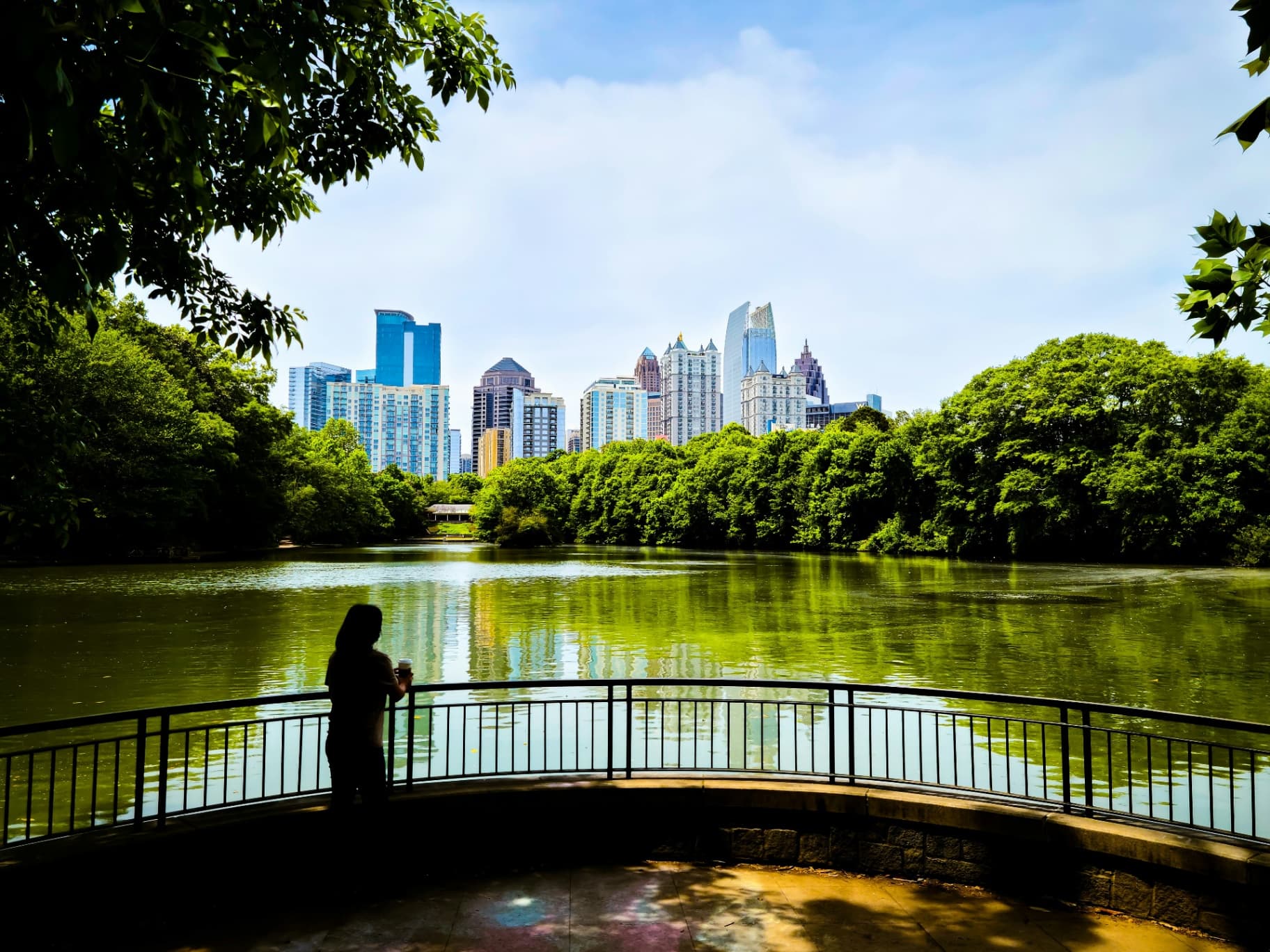
Midtown is Atlanta’s most conventionally urban neighborhood: taller buildings, a more complete street grid, and the city’s most reliable transit infrastructure along the MARTA Red and Gold lines. For active renters, the main draw is Piedmont Park: 185 acres on the eastern edge of Midtown with a 2.6-mile perimeter path, tennis courts, a swimming pool, athletic fields, a dog park, and enough open green space to absorb heavy use without feeling crowded on ordinary weekdays.
The park connects directly to the BeltLine at its southern end, which puts Midtown residents within reach of the full Eastside Trail without needing to live on the trail itself. The Atlanta Botanical Garden sits on the park’s northern edge. On weekend mornings, Piedmont Park functions as the informal hub of Atlanta’s fitness culture: 10Ks, cycling groups, yoga classes, and boot camps all coexist in the same space.
The tradeoff is that Midtown is Atlanta’s most expensive rental submarket. One-bedrooms in newer buildings run $2,000 to $2,600 and up. The neighborhood is also more of a thoroughfare than a community. It has great restaurants and retail, but the residential character is thinner than O4W or Inman Park. Renters who want urban density and park access without needing a neighborhood feel tend to like it; those who want to know their neighbors may find it impersonal.
Best for: Renters who want Piedmont Park as a daily running and fitness resource and prefer the density and transit of a more urban environment.
Virginia-Highland / Poncey-Highland
Virginia-Highland is one of Atlanta’s most livable neighborhoods by most measures, walkable commercial streets on North Highland Avenue, excellent restaurants, a tree-canopied residential grid, and proximity to both Piedmont Park and the BeltLine that gives active renters two major options within a short distance. The neighborhood runs north of Ponce de Leon Avenue up toward Druid Hills, and it has a settled, established quality that distinguishes it from the newer BeltLine corridor neighborhoods to the south.
Poncey-Highland sits immediately south of Virginia-Highland, between Ponce de Leon and North Avenue, and offers similar proximity to the BeltLine at somewhat lower rents. The Freedom Trail connector runs through the area and links to the BeltLine Eastside Trail, giving residents trail access without being on the trail directly. The neighborhood is denser and younger than Virginia-Highland, with more rental-focused buildings close to the Ponce City Market corridor.
Renters in Poncey-Highland frequently mention walkability as a core feature of daily life, Publix on Highland Avenue, coffee shops and restaurants within a ten-minute walk, and either Piedmont Park or the BeltLine accessible on foot depending on the direction. For active renters who want trail access without being directly on the BeltLine’s busiest stretch, Poncey-Highland offers a quieter version of the same infrastructure.
Best for: Renters who want walkable neighborhood character, BeltLine access via connector trail, and a slightly lower price point than Midtown or O4W.
675 N Highland
A Note on West Midtown
West Midtown is Atlanta’s up-and-coming option for active renters willing to bet on infrastructure that is not yet complete. The Westside BeltLine Trail, connecting Adair Park, the West End, and the Westside Provisions District, is partially open and under active development, with significant commercial investment tracking the trail’s progress.
The neighborhood has developed a genuine restaurant and retail scene along Howell Mill Road and around the Westside Provisions District, and new residential development has followed. Rents tend to run 10 to 15 percent lower than comparable O4W or Midtown buildings, but the Westside Trail network is not as seamlessly integrated as the Eastside Trail, and the surrounding street-level experience is more uneven. Renters who move here now are pricing in the future version of the trail.
Worth watching. Not quite the same plug-and-play active lifestyle as the neighborhoods above.
The Bottom Line
Atlanta’s best neighborhoods for active renters are organized around two anchors: the BeltLine Eastside Trail and Piedmont Park. Old Fourth Ward gives you both within easy reach. Inman Park and Reynoldstown give you the trail with more neighborhood character and slightly lower rents. Midtown gives you the park and the city’s best transit. Virginia-Highland and Poncey-Highland give you walkability and trail access via connector without being in the dense corridor.
A car still helps in Atlanta. But in these neighborhoods, it does not define your day.
Trying to figure out which of these actually fits how you want to live?
brightplace is building a better way to find your next apartment.
Explore more neighborhoods at brightplace.ai
Frequently Asked Questions About Renting in Atlanta for Active Renters
What are the best neighborhoods in Atlanta for active renters?
Four intown neighborhoods stand out for active renters: Old Fourth Ward, Inman Park and Reynoldstown, Midtown near Piedmont Park, and Virginia-Highland with Poncey-Highland. All four sit inside I-285, known locally as ITP, where the BeltLine, the park system and the walkable commercial corridors are concentrated. West Midtown is a newer option still waiting on trail completion.
What is the Atlanta BeltLine?
The Atlanta BeltLine is a converted rail corridor looping through 45 intown neighborhoods, and the full loop will span 22 miles when finished. The Eastside Trail, running from Old Fourth Ward through Inman Park down to Reynoldstown, is the most developed stretch. The Westside Trail connects Adair Park to Washington Park, and other segments are still in progress.
How much is rent in Old Fourth Ward, Atlanta?
One-bedrooms in newer Old Fourth Ward buildings typically run $1,700 to $2,400 a month, based on market estimates as of September 2026. That places O4W in the middle of Atlanta's intown rental market: more expensive than neighborhoods east of the BeltLine and cheaper than Midtown, which is the city's most expensive rental submarket.
Do I need a car in Atlanta?
Atlanta is a car city, and a car is still useful even in its most walkable intown neighborhoods. In BeltLine neighborhoods such as Old Fourth Ward, Inman Park and Reynoldstown, renters may find themselves reaching for it less than expected. In Inman Park and Reynoldstown, a car remains useful for anything east or south of I-20.
Which Atlanta neighborhood is best for living near Piedmont Park?
Midtown is the best fit for renters who want Piedmont Park as a daily running and fitness resource. The 185-acre park has a 2.6-mile perimeter path, tennis courts, a swimming pool, athletic fields and a dog park. Midtown also has the city's most reliable transit along the MARTA Red and Gold lines, though rents are the highest in Atlanta.
Where can I find cheaper rent near the Atlanta BeltLine?
Reynoldstown offers more options in the $1,600 to $2,000 range while sitting on the BeltLine Eastside Trail, based on market estimates as of September 2026. Poncey-Highland offers similar BeltLine proximity at somewhat lower rents than Virginia-Highland, with trail access through the Freedom Trail connector rather than directly on the busiest stretch.
Is Virginia-Highland walkable?
Yes, Virginia-Highland has walkable commercial streets along North Highland Avenue, a tree-canopied residential grid and proximity to both Piedmont Park and the BeltLine. In neighboring Poncey-Highland, renters frequently mention walkability as part of daily life, with Publix on Highland Avenue and coffee shops and restaurants within a ten-minute walk.
Is West Midtown a good option for active renters?
West Midtown suits active renters willing to bet on infrastructure that is not yet complete. The Westside BeltLine Trail is partially open and under active development, and rents tend to run 10 to 15 percent lower than comparable O4W or Midtown buildings. The trail network is less integrated than the Eastside Trail, and the street-level experience is more uneven.
Rent data reflects market estimates as of September 2026 and is subject to change. Verify current availability directly with each community.
brightplace neighborhood guide | atlanta, ga | 2026
How this article was made: brightplace used AI tools to help research, draft and update this article.